
Sponsored by the African Cultural Institute in Norway
April 21 – 27, 2026
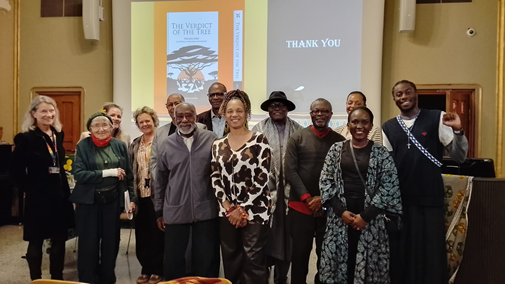
At the invitation of the African Cultural Institute in Norway, directed by Mr. Barth Niava, Afrospectives: A Global Africa Initiative Think Tank organized a book launch, a series of lectures by Prof. Augustin F. C. Holl, Prof. Yoporecka Somet, Dr. Ali Moussa-Iye, and Prof. Lisa Aubrey, as well as visits and study tours at the Historical Museum, Maritime Museum and Kon-Tiki Museum at Oslo, and the KUBEN Museum at Arendal from April 21 to 27, 2026
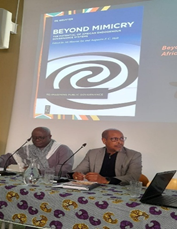
Presentation of the Book “ Beyond Mimicry” in Oslo,
Norway, 23 April 2026
by Dr. Ali Moussa-Iye and Professor Augustin F. C. Holl
Dear friends, Ladies and gentlemen,
It is a great honour to be with you today to present the book we published last December.
I would like to begin by warmly thanking the African Cultural Institute in Norway for hosting this book launch and panel discussion. My special gratitude goes to Barth Niava with whom I worked when I was directing the Slave Routes at UNESCO.
This event is the third in a series dedicated to promoting this important work, published by the renowned German publisher De Gruyter. I am also pleased to share that we successfully negotiated with the publisher to make the electronic version freely accessible—particularly for African readers, for whom this book is primarily intended.
Let me start with a simple question: How did Africa—recognised as the cradle of humankind and one of the birthplaces of the earliest civilizations — become a continent where almost everything is imported? Ideas. Institutions. Practices, Tools. Even the ways of thinking about ourselves.
This question is at the heart of the book we are launching today. Remember the hope of the ninety sixties: Independence were declared. Flags were raised. Anthems were sung. But in most of cases, the model stayed the same. Independence, even when achieved through armed struggle, was not a true rupture with the colonial system African new nations adopted all kind of ready-made templates: the concept of nation-state, copies of constitutions, of legal systems and of political rituals. Sometimes so faithfully… that they became almost caricatural. Even continental institutions established in the post-independence era reproduced this pattern of institutional mimicry.
They copied heavily models such as the United Nations or the European Union—adopting largely Eurocentric visions of governance, human rights, and international cooperation. And more than 6 decades later, the result is so disappointing, so depressing: African societies are left choosing only between socio-political structures that were not born from their own realities. This brings us to ask a fundamental question: what kind of sovereignty have African nations been able exercised in shaping their future? Are African independent countries become “choiceless states,” ?
Ladies and gentlemen, Today, however, there is a glimmer of hope. But here is the turning point.
We are living through a global crisis—not just political and economic, but ontological, civilizational. The dominant model of development is no longer sustainable. It is putting humanity and the planet at risks. And it is losing its credibility and relevance. Across the world, people are beginning to ask: Is this really the only way to organize human life and the relationship with non human entities?
Across Global Africa—the continent and its diasporas—new voices are rising. Not to reject the world. But to re-enter it on our own terms. The new generations are asking different, deep and existential questions: What does justice look like beyond imported systems? What does governance mean in societies built on relationships, not just institutions? What can we learn from our own histories?
These generations are discovering that Africa is not a blank page. It is a library. A vast one. A library of experiences and political imagination: From ancient Egypt and the concept of Maat—to the Manden Charter, to the Gadaa system of the Oromo, to the Somali Xeer, to Ubuntu philosophy, to the creative resistance of the African diaspora. These knowledge and practices are not relics of the past. They are living archives of possibility. Today, something remarkable is happening. Despite decades of Afro-pessimism, despite narratives of failure, Pan-Africanism is being reborn. Not as nostalgia. But as a project. An alternative project driven by young people who are aware and concerned of the threats and challenges Africa is currently facing: the new scramble for African resources, the question of reparations, the restitution of cultural heritage and the search for true sovereignty. All of this is happening at a moment when the world itself is shifting—toward a more multipolar reality. The empires built since 1492 on the genocides of native people; enslavement of Africans and colonial domination are collapsing as other empires in the history have collapsed. This geopolitical reconfiguration is also marked by the rise of the Global South, the emergence of new alliances, new narratives.
So the question is no longer: Can Africa catch up? The real question is: What can Africa contribute to reimagining the future of humanity? The effort to respond to this question led us to create AFROSPECTIVES: A Global Africa Initiative. A space and a forum to rethink Africa’s presence in the world—not as a follower, but as a contributor. To re-examine the African contribution to humanity.
This book is our starting point. It attempts to decolonise essential concepts and terminology used to describe our realities. For example: Instead of defining our cultural heritage as “traditional” or “indigenous,” we prefer using and redefining the concept of Endogenous knowledge and practices. Because these systems are not frozen in the past. They evolve. They adapt. They think. They have their own dynamic of change. They are not alternatives or opposed to the so-called modernity. They are other ways of rethinking and building an African modernity.
In this book, we are addressing fundamental questions: What happens when African societies draw from their own knowledge systems to organize power, justice, and life together? What lessons can we learn from current experiences in Africa Botswana, South Africa, and from historical experiences of African diaspora in Brazil and Suriname? But this work is not just an academic exercise. It is an invitation. An invitation to rethink: how we could govern our nations, how we could educate our people, how we could reconcile with our history, how we should define progress and our future?
The book reminds that behind every system of governance lies a deeper philosophical and spiritual framework, I would say, —a political ontology—that shapes how societies understand power, justice, and human relationships. Therefore, governance cannot and should not be reduced to institutions alone. It reflects and tells us about what it means to be human, to be a society, to be an eco-system of interactions between humans and non-humans, between livings and non-livings.
I would like now to invite to my colleague and co-editor of the Book, Prof Augustin Holl, to present you more in detail the different sections and chapters of the book. I thank you for your attention.
The introduction by both editors presents the fate of African countries that have mimicked European institutions and outlines the imperative for new start articulated on endogenous African and Afro-descendants cultures and historical experiences.
Part One comprises six chapters on early human social formations and ancient political philosophies and systems of governance and justice that have been developed by African peoples in different periods of time.
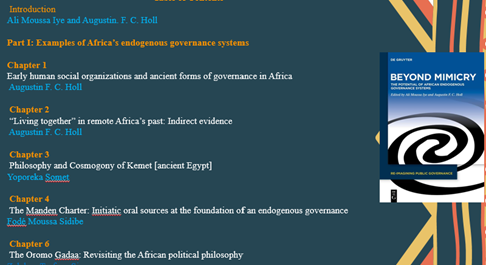
In chapter 1, Prof. Augustin F. C. Holl from Kamerun provides an overview of the first human sociopolitical formations that emerged in Africa. Drawing on archaeological records and primatology research, he analyses some aspects of the social dynamics and formulate hypotheses on early human forms of social organizations and governance.
In chapter 2, equally by Augustin F. C. Holl highlights the major African initial cognitive, scientific and material inventions, ranging from lithic technology to metallurgy, empathy and self-awareness, as well as astronomy.
In chapter 3, Prof. Yoporeka Somet from Kenya analyses Pharaonic cosmogony explains the concept of Maat, its cosmic, social and eschatological significance, and discusses how this cosmogony defines the characteristics of the Pharaonic State, considered by some contemporary Egyptologists as « the first known State governed by the Rule of Law ».
In Chapter 4, Prof. Fode Moussa Sidibe from Mali, analyses The Manden Charter of Mali Empire through the lens of a particular oral source, the initiatic oral narratives of the West African Brotherhood of Donso-hunters. He discusses the metaphysical, spiritual and philosophical foundations of the system of governance introduced by the traditional hunters, through the interpretation of initiatic words, expressions and rituals that were used in the process leading to the proclamation of the Manden Charter in the 13th century.
In Chapter 5, Dr. Ali Moussa-Iye from Djibouti presents a specific endogenous system of governance that emerged in the Horn of Africa in the 16th century known as the Issa Xeer. I will discuss this later.
In Chapter 6, Zelalem Tesfaye Sirna from Ethiopia presents the Oromo Gadaa system, as an endogenous egalitarian socio-political, and religious system developed by the Oromo people living in Ethiopia and Kenya. He will present it in detail later on.
Part Two analyses experiences of revitalisation of African endogenous systems and practices of governance undertaken in Africa and in the African diaspora at different periods of history.
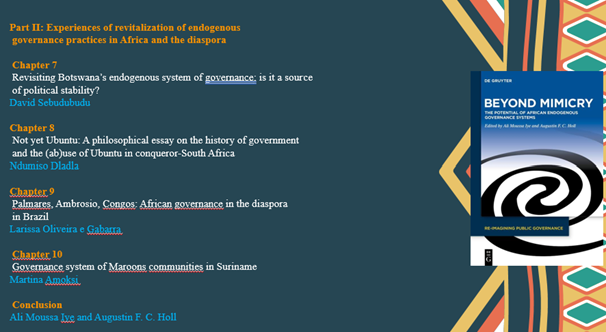
In Chapter 7, Professor David Sebudubudu from Botswana provides a critical account of Botswana’s endogenous governance system, which has been sustained to complement its modern government system, since the independence. He analyses the strategies, processes and procedures that Botswana’s modern state has put in place to institutionalise the integration of endogenous systems.
In Chapter 8, Prof. Ndumiso Dladla from South Africa, analyses the use, abuse and instrumentalisation of the philosophy of “Ubuntu” in the context of South Africa’s transition from colonial domination to democracy. He discusses the exigencies of Ubu-ntu against the prevailing order and explore the implications of this “philopraxis” for a new constitutional order in South Africa, which could frame a humane order based on the recognition of the humanness of all Human beings.
In chapter 9, Prof. Larissa Oliveira e Gabarra from Brazil analyses how Maroon entities created by Africans in Brazil reappropriated and revalorised African governance system in hostile situation, to resist Portuguese slave system. She describes the characteristics of the Maroon’s resistance such as Palmares and the Kingdoms of the Congo as authentic socio-political organisations.
In chapter 10, Prof. Martina Amoksi form Suriname analyses how many of the enslaved people from West Africa who were deported on a large scale to Suriname in the 17th century to work on sugar plantations chose freedom, fled into the immense forests inside this country and used their African ancestral knowledge about nature and human organisations to survive.
In the conclusion, the editors of the book recall the necessity to develop solid and coherent philosophical, ethical and spiritual frameworks rooted in the cultural specificities of concerned people in any revitalisation of endogenous governance systems. They highlight the urgency to transform and renovate the whole system of education inherited from colonisation and develop new contents and methods of learning and teaching to transmit endogenous knowledge and experiences from the early age. To that end, they suggested to launch national debate in interested African countries to develop a critical thinking about the revitalization of endogenous knowledge and the renovation of governance in Africa.
April 23, 2026: The Lecture Series
The Challenges of Revalorization and Operationalising Endogenous Systems of Governance and Justice
19.10 – 19.15: Introductory remarks Professor Lisa Audrey
19.15–19.35: Early Human Sociopolitical Formations in Africa by Prof. Augustin Holl
19.35–19.55: Philosophy and Cosmogonies of Pharaonic Egypt by prof. Yoporeka Somet
19.55–20.15:The Xeer Issa: Example of an African Philosophy and Practice of Governance
and Justice
20.15–20.30: Exchange with audience
Sunday, April 26, 2026:
Linking Africab Diaspora with African Development. Professor Lisa Aubrey
Museum Visits
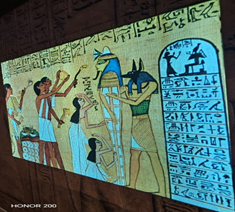
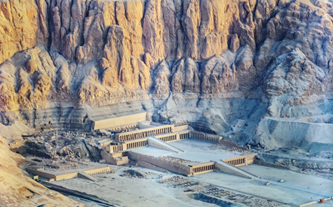
1 – Visit at the Historical Museum, especially the new Pharaonic Egypt exhibit, Oslo
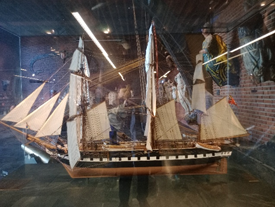
2 – Visit at the Maritime Museum
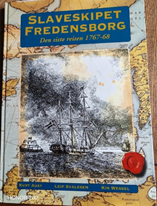
3 – Visit at the KUBEN Museum, Arendal.
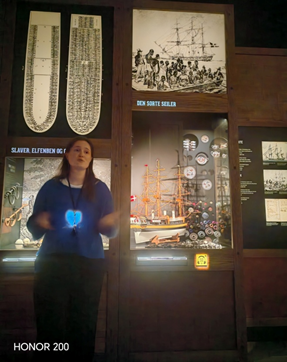
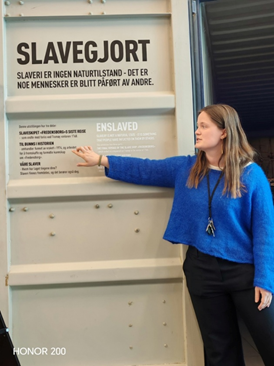

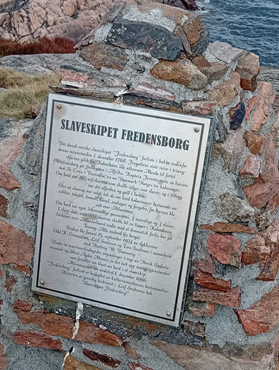
5 – Brainstorming on the Report to the museums staffs at Barth’s Home
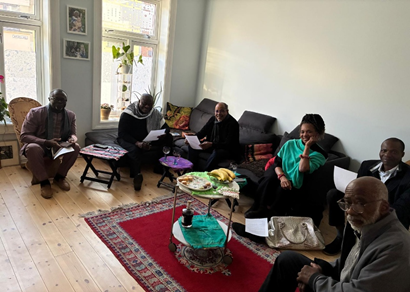
A very exciting and interesting study visit