
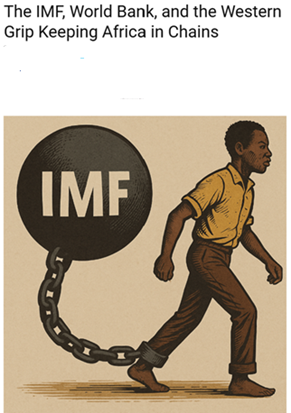
Is there any significant difference between chattel enslavement,
Colonial domination and Exploitation, and Financial Servitude?
The Answer is a Resounding NO!!!!!!!!!!!!!!
The transatlantic slave trade, which took place from the 15th to the 19th centuries, is one of the worst examples of human commodification in history. During this time, millions of Africans were made into chattel – property that could be bought, sold, insured, and traded like other goods. This dehumanizing practice was not just a moral wrong but an economic way to get value from African people for the benefit of European empires and their colonial economies.
Centuries later, as formal colonialism ended, a new form of economic control came up in the late 20th century: Structural Adjustment Programs (SAPs) set by the International Monetary Fund (IMF) and the World Bank. These programs, which were supposed to help African countries with debt problems, forced big economic changes – like selling state assets, removing subsidies, making the currency worth less, and focusing on export – led production. These changes basically gave economic power from African governments to global financial groups and big companies.
This paper says that even though the historical times and how they were done were very different, Structural Adjustment Programs are a continuation of the way of thinking about commodification that was in the transatlantic slave trade. Both systems are based on the idea of getting value from Africa by making its people, resources, and power into things that can be used by others. While the slave trade made people into chattel, SAPs made African countries’ power, natural resources, and labor into things that could be used through debt and forced economic rules. In short, SAPs are a new form of colonial exploitation that fits the neoliberal world order, keeping Africa as a place that gives value to the main global economies.
Understanding this connection is important for understanding today’s African economic problems, from debt crises to resource being used up. By looking at how commodification has changed from the slave trade to SAPs, this paper shows how old ways of exploitation are made to look new and made stronger through economic policies that seem fair. The analysis is in five parts: first, a way of thinking about commodification and why it matters for both historical times; second, looking at the transatlantic slave trade as a system of making people into things; third, analyzing SAPs as a neoliberal form of commodification; fourth, comparing the two systems to show how they are the same and different; and finally, a conclusion that shows what this means for understanding Africa’s current economic problems.
The Core Logic of Commodification
Commodification, at its heart, is the process of turning things – like objects, people, or social relations – into commodities. Commodities are goods or services made to be sold in a market, and their value is mostly decided by how easy they are to exchange, not by what they are really worth or how useful they are. This process means taking away things that aren’t about the market and making the thing only worth its money value in a market system.
In the transatlantic slave trade, commodification was very dehumanizing: people were made into chattel. Enslaved Africans lost their sense of self, their cultural identities, and their ability to make choices. Their value was only based on how much work they could do, how strong they were, and their physical qualities (like age, gender, and health). As chattel, they were affected by the same market forces as animals or raw materials. Their prices went up and down depending on supply and demand in transatlantic markets, and they were even traded as futures on places like the London Commodity Exchange.
During the time of Structural Adjustment Programs, what was being commodified changed, but the basic idea was the same. SAPs spread commodification to areas that were usually kept away from market forces: national power (because policy choices depended on loan conditions), natural resources (by making them private and pushing exports), public services (like education and healthcare, which became money – making businesses), and even labor (because wages were kept low and labor markets were made less regulated, making African workers attractive to foreign investors). In this system, a country’s debt became a commodity, and how well it could pay back the debt decided the value of its power.
Three ways of thinking help us see how this commodification idea has stayed the same. Immanuel Wallerstein’s world – systems theory says that the global economy is like a pyramid, with rich countries at the top getting extra value from poor areas like Africa. Both the slave trade and SAPs keep Africa at the bottom, making sure resources flow one way to rich economies [1]. Walter Rodney, in How Europe Underdeveloped Africa, argues that outside forces have always stopped Africa from being able to develop on its own. This started with the slave trade and continued with colonialism and post – colonial economic policies like SAPs[2]. Finally, Kwame Nkrumah’s idea of neocolonialism explains how economic control replaced direct political rule. Institutions like the IMF and World Bank act like the old colonial powers, making sure Africa is still being used through economic deals that seem like they are by choice[3].
The Commodification Mechanisms of the Slave Trade
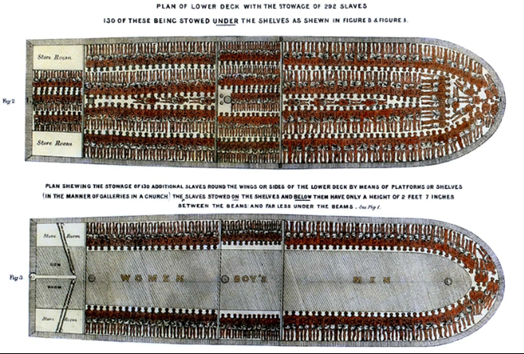
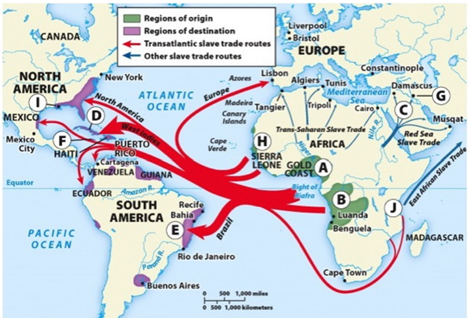
The transatlantic slave trade wasn’t just a bunch of random deals. It was a smart economic system made to get as much value as possible from African people. The triangular trade network was very important in this system: African captives were taken to the Americas to make raw materials (like sugar, cotton, and tobacco). These raw materials were then sent to Europe to be made into goods, and many of these goods were sold in Africa to get more captives. This created a cycle of exploitation, where African labor made wealth for European and American economies, but left Africa poor[4].
The way enslaved Africans were made into commodities was done through a complex system of dehumanization. Slave traders had detailed ways of pricing based on physical features. Young adult men got the highest prices because they were thought to be the most useful for work, while women were valued for both their work and their ability to have children. Insurance systems were made to reduce risks, with policies covering « losses » from death, escape, or harm to enslaved people during the journey. Even futures markets developed, letting traders guess about the future price of enslaved Africans and treating human lives like abstract financial things [4].
The long – term damage to African societies was very bad and lasted a long time. About 12.5 million people were taken away, and millions more died while being caught and on the way, which made the population very unbalanced, especially in terms of gender because young men were taken more often. This big change in the population messed up farming systems and broke up family networks, making society less strong. At the same time, European powers purposefully hurt African handicraft production with unfair trade and colonial policies. This stopped potential industrialization and made Africa depend on European – made goods. Politically, the slave trade helped warlord states grow because they made money by catching and selling other Africans. This left a problem of political splitting and conflict that still exists in many parts of Africa today[2].
Neoliberal Commodification Iterated
Structural Adjustment Programs started in the 1980s as a way to deal with the debt crisis that hit many African countries. This crisis was caused by rising oil prices, falling prices of African exports, and bad lending by Western banks. The IMF and World Bank gave loans to countries in debt, but with conditions based on the « Washington Consensus » – a set of neoliberal policies that focused on making things private, opening up markets, making trade free, and cutting spending. These conditions included getting rid of food and fuel subsidies, selling state – owned businesses, making the national currency worth less, and changing the economy to focus on exports [5].
In reality, SAPs copied the commodification idea of the slave trade in new ways. As shown in Table 1, what was being exploited changed from human bodies to a country’s resources and power, but the main idea of getting value out remained the same.
| Dimension | Slave Trade Era | SAPs Era |
| Exploitation Target | Human bodies (biological labor) | National resources, public services |
| Control Mechanism | Armed capture, trade monopolies | Debt obligations, policy conditionality |
| Value Extraction | Uncompensated labor for raw materials | Low – cost raw material exports, cheap labor for foreign investment |
| Destructive Consequences | Social disintegration, cultural erasure | Privatized education/healthcare → class stratification; peasant bankruptcy → food crises |
Ghana is a clear example of what SAPs did. Because of pressure from the IMF, Ghana stopped supporting a wide range of agriculture and started an export – led model based on cocoa. The government got rid of farm subsidies, made the cedi (the currency) worth less (which made imported things more expensive), and removed price controls on cocoa. While this made cocoa exports go up, it made farmers’ incomes drop a lot. Between 1983 and 1995, the real price of cocoa fell by 40%, pushing millions of people into poverty. At the same time, foreign companies bought a lot of agricultural land, kicking out small farmers and changing small farms into big monoculture plantations [6][7][8].
In Zaire (now the Democratic Republic of Congo), SAP – required privatization of mineral resources gave control of copper, cobalt, and diamond mines from the state to big foreign companies. This not only took away money from the country but also made ethnic problems worse because local communities lost access to their traditional lands and resources. The economic collapse and competition for resources led to civil wars in the 1990s and 2000s that killed millions of people. This is like the political splitting that the slave trade caused centuries ago[9].
A Critical Analysis
The similarities between the slave trade and SAPs show a continuous way of exploiting people and resources. Both systems were forced on Africa from the outside. European slave traders and later colonial powers decided how things would work during the slave trade. And during the SAPs time, the IMF, World Bank, and Western creditor countries made SAPs with little input from African people. In both cases, value moved in one direction – from Africa to other countries – and African societies had to pay the price. The harm to people, even if it was different, was very bad. The number of people who died on the Middle Passage (about 1.8 million) is similar to the increase in infant deaths in countries affected by SAPs, which was caused by cuts to healthcare and nutrition programs [4][9].
But there are also important differences that show how exploitation changes. The slave trade used open violence and made people seem less than human because of their race. SAPs, on the other hand, used economic ways that seemed fair – like loan agreements, market signals, and policy conditions – to hide how forced they were. In the SAPs era, a new thing was that some African elites helped. They often made money from privatization deals and austerity measures, becoming a group that helped outside exploitation. The way people fought back also changed. Enslaved people rebelled, like in the Haitian Revolution. And SAPs faced opposition from social movements, like Nigeria’s 1994 general strike against austerity measures, which stopped the program for a while[3][10].
However, these differences don’t mean there isn’t a basic connection. Both systems were used to keep Africa in a lower position in the global economy, making sure it was a source of cheap resources and labor and not a competitor in high – value production. The change from chattel slavery to debt slavery isn’t a break from exploitation. It’s just how exploitation changed to fit new global power structures while still keeping the main way of taking things [11].
Neo-Enslavement
Structural Adjustment Programs were never just normal economic policies. They were the latest form of a centuries – old pattern of using Africa for other countries’ benefit. By showing how the commodification in the transatlantic slave trade is connected to the commodification in SAPs, this paper shows how exploitation changes with history but keeps its main idea. SAPs, through debt and forced neoliberal policies, kept Africa as a place that was used for resources in the global economy, just like the slave trade did before.
Understanding this connection is very important for dealing with Africa’s current problems. Today’s African debt crises – whether it’s with Western creditors, Chinese loans, or international financial institutions – can’t be fully understood without seeing how they come from this long history of taking things. To break this cycle, we need to question the neoliberal ideas that keep unfair trade going, support African – led plans for economic power (like the African Continental Free Trade Area), and find new ways to develop that focus on internal needs instead of paying off external debt [12].
This analysis has limits. It doesn’t fully look at the differences within Africa – for example, how Botswana managed resources well even with SAPs – or the role of new players like China, whose economic connection with Africa makes the old North – South exploitation story more complicated. More research should look at these details while still keeping the critical view that historical patterns of commodification help us understand today’s African economic reality. In the end, only by admitting this historical connection can we take real steps towards economic justice and true development in Africa.
References
- Rodney, W., 1972, How Europe Underdeveloped Africa, Bogle – L’Ouverture Publications.
- Nkrumah, K., 1965, Neo – Colonialism: The Last Stage of Imperialism, Thomas Nelson and Sons.
- Britannica, 2025, Transatlantic slave trade | History & Facts, retrieved from https://www.britannica.com/topic/transatlantic – slave – trade.
- Michigan Journal of Economics, 2024, Structural Adjustment’s Complex Legacy in Sub – Saharan Africa, retrieved from https://sites.lsa.umich.edu/mje/2024/04/29/structural – adjustments – complex – legacy – in – sub – saharan – africa/.
- United Nations, 2017, The World Economy in 2050, United Nations Department of Economic and Social Affairs.